Hey everyone. Just wanted to say I’m sorry for not posting in so long, and if you were looking forward to this being another actual post about some piece of literature or show, well, I’m sorry for that too.
I’ve been going through some personal stuff lately, which does not excuse my lack of posting, but does help explain it. I hope you all will understand. When I get a chance and have the motivation and drive to write something, I will post. I simply don’t know when that will be as of yet. So please bear with me. Who knows, I may even expand this blog’s range and talk about some of my own personal issues (some of which actually do have to do with relationship stuff).
Until then, keep reading, keep writing, keep watching, and most of all keep thinking. Don’t drive yourself crazy with it though, like I do. Have fun with it.
A short post this week—it’s time to write final papers already!—and a simple one. In my short story class this week we are going to be discussing Hemingway and Faulkner, and I am more than excited.
I love Faulkner’s writing because, well, I love his writing. I honestly wish we were studying his novels, but this is a short story class after all, and his short stories are a bit easier to follow and understand than his novels. But Faulkner’s novels are what really make him a good writer, I think—his short stories are so typical, conventional. They’re very good, and they do contain hints of his stream-of-conscious style. But his novels are so much better, in my opinion.
Still, we’ll be looking at “Barn Burning,” a textbook favorite and one of my favorites, as well as “A Rose for Emily,” which isn’t bad but doesn’t excite me nearly as much. I don’t know why; maybe it’s because of the lack of strong voice, or the focus on a female main character. Anyway, I’m excited.
And I’m excited for Hemingway. I’ve never read any of his novels (it is true, sadly), and I am not the biggest fan of his writing style—it’s almost too sparse for me, too lacking in emotion, and most of all the rhythm of his phrases and sentences is too static, too unchanging, too similar. However, his style did revolutionize the short story and prose in general. When you read Hemingway, you know it’s Hemingway. The sparseness of his prose makes the reader think deeply about what is really going on, and despite the inherent lack of emotion in the text, it does draw out a certain emotional quality. Every time I read Hemingway I am struck with some deep longing, even though I cannot exactly define it. All I know is it comes from what is unsaid—or, perhaps more correctly, from the difference between what is on the page and what is not. Maybe that’s the beauty of Hemingway.
If I’m not too busy writing papers I might update you all on it. I’m sure it will be an exciting week. If anyone doesn’t like Faulkner I will jump to his defense (maybe—or I might just repeat, “It’s just an opinion” to myself over and over). Do you like Faulkner and/or Hemingway? Why or why not? I’d like to know your thoughts, so please leave a comment.
Mansfield in 1920. She even looked independent. Courtesy of The National Library of New Zealand.
Recently for a short story class I had to read a couple of Katherine Mansfield short stories. I think I may have read one of them (“Miss Brill”) before, but if I have the recollection is entirely vague, and for all I know I may be making up the whole thing. The other story, “The Garden Party,” I had never read before, and it was delightful. Katherine Mansfield herself is delightful; I feel like I’ve just stumbled upon gold.
Without spoiling the stories for you, I thought I would give some of my thoughts on Mansfield’s style and why I enjoy her so much:
Her stories read like postmodern works. Virginia Woolf and James Joyce were writing at the same time as Mansfield, and yet for some reason Woolf’s and Joyce’s stories feel period-bound—I mean when you read them, you know the story was not written today.
But Mansfield is different. Of course she does not sound entirely contemporary, but her writing comes off much more contemporary than man of her peers’. This is in large part because of her stream-of-consciousness style that is not overbearingly stream-of-consciousness (like Joyce and Woolf are at times); she manages to combine great internal thought and dialogue with external description and action.
Also, even though many of Mansfield’s stories are written in third person, her characters have very strong voices, so it nearly feels as if you are reading a first-person narrative. Of course Woolf does this as well, brilliantly (see “A Mark on the Wall”), but Mansfield, I think, does it a bit subtler and a bit more naturally. I’ve read that Mansfield’s prose was radical for the time period; it reads wonderfully today as well. For some reason her stories read very timeless to me; I could see a contemporary author of today writing them, as sort of “historical fiction.”
Also, Mansfield evokes emotion without beating the reader over the head. (Joyce does this, too, but I don’t feel as much emotion with him as I do with Mansfield). She by no means reveals too much; if anything she is very subtle—typically modernist. I think especially of the ending of “The Garden Party”; I was struck with a very strong emotion, multiple emotions in fact, which I could not really identify but I knew very well. I knew what the protagonist was feeling; I knew that overwhelming mixture, even if I could not articulate it.
Women modernist writers don’t usually light my fire that much; but Mansfield is an exception. If I have time I might find read some more of her stories.
Note the title of this post says “initial” thoughts; I may write more on Mansfield later. In the meantime, I would like to hear your opinion of Mansfield, if you’ve read her. (And if you haven’t, please do! “Miss Brill” is quite short.) As my professor might say, how does she “land” for you? Tell me in the comments!
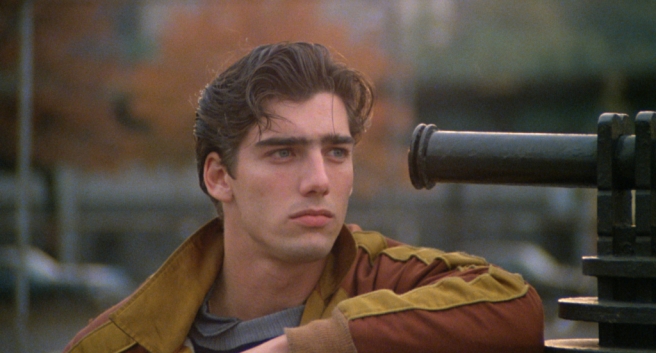
Richie Gennaro. Courtesy of Kino Lorber, kinolorber.com/film/view/id/2378
After a hiatus from analyzing characters in the film version of The Wanderers, I’m back on the ball . . . and on to the most important characters, at least in my opinion.
Here we come to the central character in this film: Richie Gennaro. Man of the hour. He is the most complex, and, I would say, realistic character in the film. (And Ken Wahl is of course a large reason for this. He gives a great performance.)
The first glimpse we get of Richie we see that he is sex-, and possibly love-, obsessed. But very soon we realize love takes a back seat to his buddies. Richie is a very loyal guy, when it comes to friendship. Girls are a different story; girls are less friends than girlfriends, signifying not friendship but romance. Yet Richie is very loyal to his friends.
He is an interesting leader for a gang. He seems confident, but right away we see he is just as insecure as the other members of the Wanderers, especially against the Baldies. He shakes and sweats just as much as Turkey and Joey and Buddy. When Perry comes on the scene, his calmness makes you think that maybe he should be the leader instead.
But Richie has been the leader, and it seems always will be. Perry never even questions his authority. Yet Richie’s insecurities are perhaps more obvious than the other members’. This is in part because the film focuses on specifically Richie’s insecurities a lot, but also because Richie does not always act “perfectly.” He is not always tough; not always one hundred percent confident; not always steady as a rock; not always blank-faced, as one might want a gang leader to be.
See his response to the impending football game/rumble with the Del Bombers. He is nervous, and even around Despie can’t seem to hide the fact. Later, with the Wongs, he is visibly spooked, at a time when you would think he would want to assert his toughness.
Side thought: later the Wongs do come through for Richie. Why? Is it because they respect Richie and the gang—and if so, do they respect the gang as a gang, or Richie himself as a leader, or both?—or just because they see the Ducky Boys’ reign of terror as inherently unfair? Or both?
Regardless, Richie is not the toughest gang leader out there, at least judging by appearances (and in these boys’ world, everyone judges and is judged by appearances). He certainly appears much less tough than Clinton Stitch or Terror. And with the Galasso brothers, he is just another scrawny teenage kid. He feels he has to play it cool because he is the gang leader, but really he is no calmer than Buddy or Joey. He is equal to them; just another boy like they are, scared of older, powerful men whom he respects.
In short, Richie is connected to his emotions, more than the other gang leaders—because he acknowledges them. As a result he often wears his heart on his sleeve. (I’d be interested to know how he has made it in his tough neighborhood with this tendency; where did he learn to act this way? What is his family like? We don’t get any information about his family life, sadly, so we’re left to guess.) He can’t help but let some emotions seep out—most of the time.
Sometimes, though, he is utterly cool; that is, when he is with girls. Girls, to Richie, are beauty and sex, and for some reason he can keep his emotions in check with them. I would propose this is so because girls mean less to him than his friends and gang life do. When something means less to you, you care less about it, and so you have less emotion to keep in check.
Nina, of course, messes this whole system up. Richie is genuinely infatuated with her, though she’s not his girl. It is precisely because Richie is gang leader and so loyal to his friends that his betrayal of Joey is so shocking—especially shocking to Joey himself. For once (possibly the first time, judging by both Richie’s and Joey’s reactions) Richie’s loyalty goes to the girl and not to his (purportedly best) friend. For once a girl has gotten through to Richie, made him feel some real emotion, not just a conjured-up desire for sex, and he leaves his gang life for a girl.
Yet his loyalties swing back to the gang very quickly. Whether he knows he can’t have Nina or not, Richie seems more than willing to forget and get back to the way things were. Joey’s quick acceptance of Richie’s simple, heartfelt apology shows that Richie is, to his gang members, a stand-up guy (or at least was until recently), a guy his buddies trust, who is honest and truly invested in the gang members’ well-beings.
This is why Richie is leader of the Wanderers. His loyalty will ultimately always be to his friends. He doesn’t get Despie pregnant on purpose, because he loves her and wants to be with her forever; he is using her for his own enjoyment. He would never truly use his friends for his own enjoyment, at least not to the same extent I don’t think. Yes, Richie may tease his friends, even harshly at times, but he is also responsible for them, and comes through for them (most of the time). And the person he teases most, Joey, is stated more than once to be his best friend.
Richie is a bit fond of teasing, as we see in the scenes of him and Joey in Perry’s car and waiting for Nina, and by his snide remark that “Perry can sing.” Like any other teenage boy he likes a good laugh, and it seems he most teases those people about whom he most cares. But deep down he is a very serious kid. He takes things seriously and thinks deeply—even about romance, though in that case he is perhaps less serious because he’s less caring; less emotionally invested.
Thus Richie never openly teases girls, because he wants to earn their trust so he can get what he wants. I wouldn’t say Richie doesn’t care about girls—but he definitely is okay with loving and leaving them. He may or may not come through if his girl is in trouble.
While Richie’s loyalty is a positive attribute, it is also his undoing. He can’t let the gang go. This is most obvious when Joey and Perry announce their eminent departure. Richie can’t believe it. “You can’t do this to me,” he says to Joey—a plea if I ever heard one. Deep down, Richie craves loyalty, even more, I think, than sex. This is also why he is the leader of a gang; as leader, he is responsible for promoting loyalty, both in himself and in the other boys.
So Richie is a rather serious, incredibly loyal, sex-obsessed, and very typical teenage kid. He isn’t prone to thinking too much about consequences or the future. He is afraid of people who can hurt him, and admits that fear at least to himself. He seeks to hide his “negative” emotions and remain cool at all times, but utterly fails. In short, he is like every one of us. He is quite real.
According to S. E. Hinton, October 8th is Soda’s birthday. (S. E. Hinton gave this date when she was asked about characters’ birthdays on the set of The Outsiders TV show-the best proof I can provide is a Yahoo! Answers post, so I’m sorry.) Today he would be sixty-seven or sixty-eight, depending on when you believe The Outsiders takes place.
If you’re a reader who believes in sticking to the author’s game plan, then you know Soda’s been gone for a quite a while now, a very young victim of the infamous Vietnam draft and warfare. (This is per The Outsider Complete Novel DVD commentary and a very obscure interview Hinton did with Penguin. I tried to find that interview, as I’ve found it before, but it seems to be missing.) Yet he will live on in our hearts.
Regardless, we hope this “always happy-go-lucky and grinning” guy with “lively, dancing, recklessly laughing eyes that can be gentle and sympathetic one moment and blazing with anger the next” still gets drunk “on just plain living.” If anyone knows how to live life, it’s Sodapop.
So happy birthday Soda, wherever you are. Drink some chocolate milk and eat some green pancakes, or maybe purple, and eggs with grape jelly, and chocolate cake for us. Lots of chocolate cake. Try to leave some for Steve, though since it is your birthday you’re fully allowed to eat all the cake.
And to all who served in Vietnam, still with us or not, thank you for your courage and your strength. You will never be forgotten.
After a bit of an absence, I return to my blog wondering about . . . fiction. (Surprise!) Fiction in general.
Why do I like fiction? More specifically, why do I like fiction more than nonfiction?
Truly, I do. I’ve tried to appreciate nonfiction, and as I’ve grown as a person and a reader and writer, I have grown to like some nonfiction, like creative nonfiction and biographies. But overall, fiction gets me much more excited than nonfiction. I look at a book about a fictional pioneer girl traveling West in the 1840s with her family, and I think, “Ooh, sounds good.” And I look at a book about pioneers traveling West in the 1840s, and I think, “Oh yeah, probably is informative,” but I dread having to read it. (Usually I don’t ever end up reading it.)
I’m not trying to bash nonfiction; much of it is good, and many people like nonfiction more than fiction. But I’m not one of those people. And maybe, if you’re reading this blog, you’re not either.
So what is it about fiction? Why do I care so much about worlds that are—let’s face it—not real? Isn’t it smarter to focus on the real world?
Nonfiction Is, Well . . . Dry
I interned at a newspaper this summer. I learned a ton, and to my great surprise found I really enjoy reporting. I do.
Nearly every day this summer, I read at least one newspaper article. And honestly, I found most of those articles interesting.
But there’s something—well—dry about newspapers. I read them to become a better reporter, but not for fun. Maybe it’s because I get most of my news from TV. I do read the paper every so often now, however, and I appreciate different reporters’ perspectives.
But if I’m going to sit down and read something, I want to enjoy it. Somehow I enjoy watching the news on TV—and debating it—but reading it in a paper is not so fun. Likewise, I find many nonfiction books rather dry. Not all of them, of course, as I will show below. But generally, nonfiction comes off, at least to me, as static. A bit dull.
When I read I want to have fun.
And Fiction Is, Well . . . Fun
Part of what makes fiction so enjoyable, for me, is that it is personal. It brings worlds to life by focusing on the life of one individual (or maybe a few).
I’m not a big sci-fi or fantasy person, but I can see how, if you like those worlds, those stories are very enjoyable. I’m much more of a fan of realistic fiction. Some might ask, “Why do you like that stuff so much? Don’t you have enough real life as it is?”
Yes, I do have enough—of my life. The joy of realistic fiction, for me, is getting to live as somebody else, in that somebody else’s world. Even if their world is in the 21st-century United States, even if it’s in my home state, it’s still their world, not mine, and so it is inherently different from mine.
I suppose I like fiction because it expands my views and mind, but in a very fun way. I’m not bored when I read fiction (unless of course the book is The House of the Seven Gables–Hawthorne fans, don’t shoot!); at least not in the way I may be bored reading nonfiction.
Choosing to Dwell In Dreamland—A Mental Health Concern?
But what about that fictional aspect? A nonfiction piece might put me in the perspective of one person, just as fiction does. Why do I enjoy being a fictional character more?
First of all, there are a few nonfiction books that I’ve devoured exactly because of this reason (and because, usually, I’m interested in the subject at hand). For example, Rosemary: The Hidden Kennedy Daughter, by Kate Clifford Larson, is very good. So is Jack and Lem by David Pitts. The latter focused very much on one person; while the former did not as much, it did focus on one family. Thus, both books were very personal—very narrow in scope, somewhat like a novel. My enjoyment of them was also helped by the fact that I am very interested in the Kennedy family.
But overall, nonfiction books just don’t hook me as much as fictional ones. And I love history. Again, why the love for fictional characters? Do I have some sort of mental imbalance, that I prefer learning about and living the life of a made-up person to that of a real one?
I don’t think mental imbalance has much to do with the issue.
The only reason I can think of is that novelists tend to write from their characters’ perspectives in much more creative ways than nonfiction authors. Nonfiction authors often write in a detached, reporting, historian-like style. This is ideal when transferring information, but not quite so ideal for getting the reader truly into a person’s mind.
Fictional writers tend to dwell on their characters’ motivations, thoughts, and internal conflict to a much greater extent. Of course authors sometimes do let their third-person narrators go off on rants—and in this way one could possibly argue first-person novels are even more fun than third-person novels (which I believe, but that’s only one reader’s opinion). Yet even third-person novels are often much “closer” to their characters, in a personal way, than nonfiction books.
Maybe showing versus telling has something to do with it.
Think of Ray Bradbury’s Dandelion Wine compared to, say, a book on middle-class life in the early 20th century. The scene of Douglas trying to convince his father to buy him new shoes, as compared to, say, “When he saw those shoes in the store window that day, the young Douglas knew he had to have them, but try as he might he couldn’t answer his father’s question as to just why he need them. So he went home empty-handed . . .”
Maybe that claim about novels being “closer” to their characters is unwarranted. But that’s the only reason I can think of for why, ultimately, fiction draws me in more than nonfiction.
Dialogue also has something to do with it—nonfiction often can’t include the details fiction can, because the writer doesn’t know for sure what a person said. In fiction, the author knows exactly what the person said.
Fiction personalizes. That’s about the gist of it.
I was fortunate enough to attend a showing of The Outsiders at the beautiful, historic Crest Theater with my mom this past Friday night. The theater, which now holds stage shows, is now also showing old(ish) films every so often, and The Outsiders happened to be one of them.
The Crest is absolutely gorgeous, restored to its former Art Deco glory, with lush golden and red curtains, gold-paneled walls and ceilings, and ornate wall lights.
The atmosphere this night was enhanced, though, with 1940s music and the ever-increasing crowd of fellow fans. There was a real sense of camaraderie. Plus, a reporter from a local TV station was there, interviewing various people. (No, he did not interview me, and frankly I was okay with that.) He actually filmed the whole movie.
I’ve seen the original film twice, the complete novel two or three times. But I had never seen The Outsiders on a big screen. I was so excited. I figured since the films being shown by the Crest were older, this would be the original version of The Outsiders. Not as good as the complete novel, in my opinion, but I told myself I was lucky just to be seeing any version of the film in an historic theater.
But it wasn’t the original film. It was the complete version as put together by Coppola in 2005. Watching the opening credits, I leaned over to my mom and whispered, “I think this might be the newer version.” There is a difference in the credits, and I was fairly sure these were the newer ones.
And then the steady piano of Jerry Lee Lewis faded in, and I knew. It was the full version. I couldn’t have asked for anything more.
Before I mention some things I noticed in the film, I have to say that it was very entertaining just watching and listening to the audience. As each greaser appeared in the opening credits, he got cheers. Then, as each character had his moment, he got cheers again—or should I say, the actors got cheers, except for Tom Cruise who got booed (though he was really very good as Steve). C. Thomas Howell, Ralph Macchio, Matt Dillon, Emilio Estevez. Patrick Swayze even had his own cheering section. And when Matt Dillon turned around in the hospital bed and proclaimed, “Let’s do it for Johnny, man—do it for Johnny!” everybody erupted. I smiled.
It was a crowd of people who were just as crazy about the book and film as I am, and it was wonderful. My mom was a saint for putting up with it
Here are some things I noticed about the film, seeing it on the big screen for the first time:
The cinematography. Oh my goodness, it’s even better in the theater. Even the opening credits (which I have to admit I prefer in the original 1983 version) were stunning; the gold-drenched still images of urban Tulsa were eye-catching. And all the sunsets and sunrises in the film—I never realized before how many there are. Other shots were gorgeous, too: the split screen (not sure if that’s accurate, I can’t think of the term) of Johnny cleaning his blade and Bob lying dead; Two-Bit and Ponyboy walking up to the lot in the twilight to meet Cherry (the shadows!); Rob Lowe and C. Thomas Howell in bed together (that whole scene is absolutely stunning with all the shadows playing on the boys’ faces). Soda does indeed look like a Greek god come down to earth, in Ponyboy’s words.
At the very end of the film, when Ponyboy is back at his desk, he takes a picture down from his bulletin board. For some reason I never really wondered, until this viewing, who is in that picture. Just who is it? I assume it’s the guys—Dallas and Johnny included—but I wasn’t able to get a good view of the picture. Anyone know? I’ll have to put on the DVD and play that scene back.
Diane Lane’s beauty. She is stunning in any version of the film, but seeing her on the big screen only confirmed that beauty.
The thoroughness of the film. Coppola doesn’t scrimp on details; he shows us a ton of them, even if they’re things that don’t really have to do with the story. For instance, he shows little things in the Curtis boys’ house, even though we don’t really need to see these things to understand the story: the piano with family photos on it; other photos on the wall; the bathroom, with shower curtain; the living room with the TV in the corner; Tulsa’s channel six test pattern (the actual one shown in real life!); Soda and Pony’s bedroom with the bookcase behind the pillows; Two-Bit drinking a beer from out of the Curtis’ fridge. Also, Ponyboy bouncing one of those tiny little bouncy balls walking home from the movies; how pointless and yet how delightful, because it’s so him. The “Rogers” decal on Bob’s Mustang; the neon “Bud” sign in Buck Merrill’s window; the “North Peoria” sign on the front of the city bus. There are so many details, everywhere, and I’m glad Coppola didn’t cut any out. They only solidify the world more.
My mom doesn’t mind the story I don’t think—she’s seen the film once before—but she’s not too big of a fan. She doesn’t like the fighting, and after this viewing she informed me she didn’t think the acting was all that great. That killed me—but maybe I’ve seen the film too many times and am just biased towards the actors and characters. She did think Ralph Macchio was good, though, and she liked the new scenes that weren’t in the original version.
But she did think the film was slightly cheesy. I guess I can see how it might be, especially to someone who has only seen the film as an adult. At times, perhaps, Howell’s acting was not as natural as it should have been—and yet I think it was wholly natural, because as he says, he wasn’t really trying. He was just being Ponyboy. And besides, the book itself is melodramatic, and the film, a very faithful adaptation of the book, can’t help but be melodramatic too.
And my mom doesn’t like the violence—a lot of people don’t. Well, neither do I, honestly. But when I hear that complaint, I want to say, “But this is these kids’ lives! This is many kids’ lives! This is how they feel, this is what they go through! We can’t just deny that.” Kids do get gunned down by police for carrying a gun, even if an unloaded one; kids do get abused by their alcoholic parents; kids do become alcoholics themselves; kids do drop out of school; kids (boys mainly) do fight. It happens. So many kids live this life that’s portrayed in The Outsiders. We can’t just pretend that at least some part of it isn’t real.
What are your thoughts on the film? Cheesy? Melodramatic? I’d love to hear them.
I’m not trying to make excuses, honest, but a somewhat-unexpected class change this weekend has led to much reading and not much time for anything else. This blog post may not be the most intellectually deep I’ve posted, but I needed something light.
Still, the topic is intriguing: Detective Sergeant Hutchinson’s mustache.
In all its glory. Courtesy of chezflipper.skyrock.com.
Some people love it; some people hate it; some people don’t seem to think it makes any difference. The question is, why did Hutch grow a mustache in (or just prior to) season 4?
There are many, many ways you could explain this. These are just my thoughts on what some of those ways could be, and what my view may be personally.
You have to take into account the blend between actor and character. Ideally it shouldn’t be there of course, but especially in a visual medium like film, it is there. It just is.
I’ve researched and researched. Originally, I could only find evidence of David Soul having a mustache as Hutch. I was hoping that he only grew it for the character—and was about to make that conclusion, when I came across this photo:
According to Alamy, the photo is from May 17, 1978.
Now, you can never put your faith in the accuracy of these things online. But I’m not inclined to doubt the information, either. That date would put the photo squarely before filming started for season 4 of Starsky and Hutch (unless I have my timeline wrong, but I don’t think I do), which implies that Soul grew the mustache either for another acting role, or just for his own enjoyment. (Why anyone would grow a mustache for his own enjoyment is beyond me, but then, I’m not a man . . .)
I can’t find any evidence that suggests Soul grew the mustache for another role. That doesn’t mean he didn’t, but for now, I’m inclined to think he grew the mustache just for kicks. From pictures I’ve seen of him later in 1979 (from Salem’s Lot, and other music-related and off-set photos), it seems he shaved the mustache soon after Starsky and Hutch ended.
So why did he grow it? I have no idea. I can’t get into the man’s head. What I know is, he grew the ‘stache.
What he must have known was that, if he was going to keep the mustache into the fall of ’78, the mustache would radically change Hutch’s image. However, so would Soul’s longer hair, back brace, and necessarily baggy, untucked shirts. These things make Hutch appear much more casual, and to some viewers, less slender.
Of course, Soul couldn’t help his back injury. Perhaps he saw himself and realized Hutch wasn’t going to look the same anymore, no doubt about it, and he thought, What the heck, let’s keep the mustache too.
From what I know of Soul, he wouldn’t have kept the mustache without taking into consideration what it would do for the character of Hutch. Soul, along with Glaser, was incredibly invested in his character and character-building (they were the two who made Starsky and Hutch are deep as they were, I believe). He had to maintain a certain continuity . . . at least in basic personality. You could argue the mustache was a fashion change, a purely external change.
Yes, but it still changed how people viewed Hutch, and Soul had to know that. He knew he was changing his character, but for some reason went ahead with it.
Why the change? And why the fourth season? Soul had gone three seasons clean-shaven, the golden boy. Now, after several years, Hutch suddenly grows a mustache. Why would he?
Some say it’s part of the overall change of the character. While Starsky changed in the fourth season, too, he didn’t change nearly as much as Hutch. Some say Hutch, in the fourth season, has become so worn and wearied by police work (which is very probable) that he starts letting things go a little. See http://fanlore.org/wiki/Hutch%27s_Mustache.
Some people say Hutch’s attitude, even his personality somewhat, changed as well in the fourth season, which I think is easily backed up (see the previous link as well as the excellent Compendium, https://archiveofourown.org/works/5815615), but that’s for another post.)
Others say he grew his mustache to assert his masculinity, citing sexual tension between him and Starsky (see above Fanlore link)—which I toss right out the window.
Or maybe Hutch just wanted to have a little fun.
I’m inclined to believe the first view, because of another factor. It’s obvious David Soul and David Starsky were both aging (as if people don’t age!); even though only four years had gone by by the end of season 4, still, four years had gone by. Both men were closer to forty than thirty.
You can see this in Soul’s face by the end of season 3. Still, there is a drastic difference in season 4. It’s true that mustaches make men look older; perhaps the mustache or ever-lengthening hairstyle contribute to this impression. But there are lines on Hutch’s face in season 4; so many lines. It’s like the man aged a million years in a few months.
From “Class in Crime,” season 3 episode 18. Not the best shot, but you can see the aging even here. Courtesy of http://www.starskyandhutch.info.
From “Deckwatch,” season 3 episode 23, the last episode of the season. Courtesy of starsky-hutch.livejournal.com.
First episode of season 4, “Discomania,” and the ‘stache has appeared. Courtesy of http://www.pinterest.com.
Another shot from the same episode. The shirt is tucked in, but look at that face. Courtesy of http://www.gettyimages.in.
(That raises another question, of course, of how much time is supposed to have passed between seasons 3 and 4—but that’s not for this post.)
He just looks older. Starsky does, too, but at times he doesn’t. Hutch, on the other hand, looks older all the time.
I have a hard time believing Soul didn’t just miss that fact. I don’t know if he and Glaser got to see film of season 4 before it aired, but I would bet they saw something of themselves. If Soul (or the director, or producer) didn’t want Hutch to look so aged, he would have done something about it. Makeup, hair change, different lighting. Something. But obviously Soul was okay with the look.
Which tells me he meant for Hutch to look older. Which meant Hutch was undergoing some serious changes, and probably some serious struggles.
Which is why I support the first opinion I listed, that the brutality of police work is finally catching up to Hutch (it did take a long time, but hey, he can be pretty idealistic underneath the surface), and as a result of the stress—and the doubts he has, perhaps, of continuing in police work (see Targets Without a Badge especially)—he looks older.
Maybe I’m making a lot of assumptions. But I have to explain that ‘stache somehow, otherwise I might just go crazy every time I see it. (If you can’t tell already, I lean more towards the camp that doesn’t like the mustache—only because I’ve seen Hutch without one for so long. But, what can you do.)
**SPOILER ALERTS AHEAD (although if you’ve even seen the film you shouldn’t be surprised at these)
So I finally finished The Wanderers novel. The last two chapters were some of the best I think—everything coming together.
Yet the ending was incredible sad. Just when everybody is united as ever, they’re also more divided than ever, and as much as one moment seems very satisfying and brotherly, you know all the guys are going to go their separate ways. It’s awful to see them growing farther apart.
Richard Price is a darn good writer. He writes matter-of-factly, without much explicit emotion, and yet he writes so sympathetically. He knows his characters; he knows his subjects. He knows his setting, too. The references to records (the music kind) in the novel are amazing.
The Wanderers is a good book, a very realistic book, but depressing. Depressing because of the characters’ behaviors, and depressing because of their eventual split, even if they do mature a little bit. And that maturing is not always the right kind.
Maybe I’ll think of some more stuff to say about it later, but for now that’s about all I can dwell on it. It is very sad.
So to get myself in a better mood, focused on something more positive (and lighthearted), I dwelt on Starsky and Hutch instead.
Don’t you just love Starsky’s hat? I’m not sure if he looked better with the short hair and cap in the pilot, or with the longer hair in all the episodes. Courtesy of starskyloveshutch.tumblr.com.
Ah. Much better. It’s interesting; these two are similar to The Wanderers inasmuch as they are two male friends, who deal with a lot of violence, in a pretty violent world. Yes, some horrible things happen to this pair, and they do have fights of their own. But ultimately they stick together—closer than brothers. It may be a fantasy; friendships do end, after all. But then, maybe not.
The friendship endures, even despite the tumult of the fourth season. Courtesy of fatheadfollies.com.
I love the physical touching between these two. Blows societal gender rules out of the water. So much for real men being tough and unemotional. I’m sure I’ll do a post about that sooner or later—I recorded a podcast about it, which I may put up at some point if I can get over the sound of my voice—but right now let’s just admire the guts of Soul and Glaser to engender (no pun intended) such deep characters.
For your enjoyment, and frankly mine as well, here are some pictures of the two (characters and actors) I love.
I don’t like stock photos either, but this is the only decent quality version of this photo I could find–and I couldn’t leave this one out. I just love it. Courtesy of http://www.alamy.com.
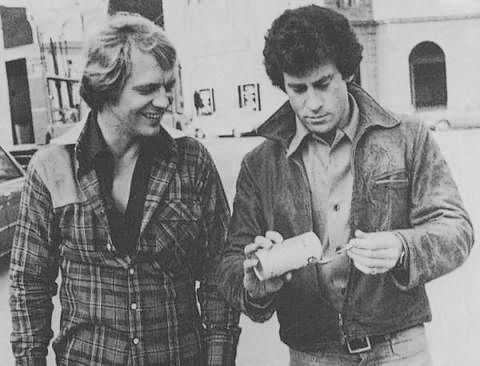
I love this series of pics. Here is the first one. Notice the can in Soul’s hand. Beer, perhaps? Courtesy of YouTube.com.
Actually I hesitate to say these go in any “order.” But it’s clear what the general sequence is. What is Soul doing? Who knows… Courtesy of http://www.starskyhutcharchive.net.
“No, but I’d sure like to,” Soul responds. I have no idea what they’re doing, but their joy is palpable. Courtesy of http://www.pinterest.com.
Soul had a thing about kissing. Well, they both did I guess, if you watch the blooper reel on YouTube (link posted below). But this picture is quite charming. Courtesy of http://www.squidge.org.
Don’t worry, I’m still continuing to analyze The Wanderers from the film. Thankfully that’s much easier than analyzing the guys in the book; the movie is not quite as dark.
Darkness is real, but light will overcome it. Dwell in the light, everyone. Or, as Johnny might say, “Stay gold.”
It includes letters from Hinton to her publisher (I’m getting the book just for those), personal pictures, original media coverage, and more. I’m so excited people. And I hope you are too. You can pre-order the novel now, or wait until November 1st, although who’d want to do that?
On another note, please also check out Danny Boy O’Connor’s amazing renovation of the Curtis House. Here’s the link to the Facebook page:https://www.facebook.com/theoutsidershouse/.
I’m always hesitant about these things, but O’Connor seems serious and dedicated, and I’m always for preserving a piece of history, especially a Craftsman house, and especially this house.